
From the Battlefield to the Ring: The Hidden Architecture of Thai Martial Arts
Most people know Thai boxing as a high-octane modern ring sport—the "Art of Eight Limbs" seen in stadiums and on TV. But beneath the gloves and the bright lights lies a deeper, older soul: Muay Boran.
At Trifecta MMA, we take immense pride in preserving this heritage. While Muay Thai was refined for competition—focusing on scoring and athlete safety—Muay Boran (Ancient Boxing) was forged for the battlefield. When a Siamese soldier was disarmed, his body became his last line of defense. This wasn't about winning points; it was about survival.
The "Sinlapa": Boran as the Pure Art Form
While the modern sport is defined by efficiency, Muay Boran is the true Art form. In the ancient tradition, a warrior wasn't just measured by his ability to land a strike, but by the grace, precision, and spirit of his movement. This is why we still practice the Wai Kru and the rhythmic flows of the Mae Mai forms.
When you practice Boran, you aren't just "training for a fight"; you are performing a physical history. The low, wide stances of Muay Chaiya or the acrobatic leaps of Muay Lopburi are as much about the aesthetic beauty of human mechanics as they are about combat. It is the "dance" of the warrior—a way to preserve the soul of Thai culture through motion.
The Four Pillars of Mastery
To truly master the strike, you must understand the source. In our curriculum, we categorize the "vocabulary" of the art into four distinct pillars:
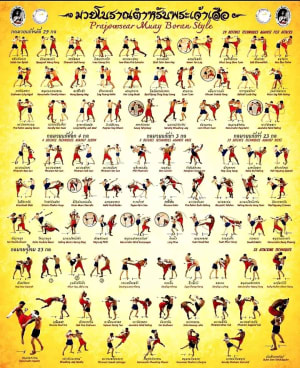
Chern Muay (The Dictionary of Weapons): The technical study of your tools. It’s not just "throwing an elbow"; it’s mastering the 8 distinct paths an elbow can take.
Kon Muay (The Strategy of Combat): If Chern Muay is the weapon, Kon Muay is the manual. This is the "chess match"—learning how to counter a specific attack (Kae) and how to break an opponent's guard (Jomti).
Mae Mai (The Master Roots): The 15 fundamental forms. These legendary techniques, like Salab Fan Pla (Zig-Zagging), teach the core principles of balance, timing, and distance.
Look Mai (The Advanced Refinements): The 15 "Minor" or advanced tricks. These are complex, deceptive movements and acrobatic finishes reserved for those dedicated to the path.
The Science and the Art: Why We Teach Both
At Trifecta MMA, we bridge these two worlds because we believe a complete martial artist needs both the Science and the Art.
The Science (Muay Thai): Gives you the timing, the conditioning, and the "live" application to defend yourself in the modern world.
The Art (Muay Boran): Gives you the technical depth, the historical context, and the creative expression that keeps the practice meaningful for a lifetime.
By training the Boran roots alongside modern Muay Thai, you develop better balance through traditional stances, greater versatility in the clinch, and a profound cultural connection to the warriors who came before us. You learn to move with a level of sophistication that goes beyond just "hitting hard"—you learn the why behind the how.
Carry on the Legacy
Whether you are a seasoned fighter looking to add "hidden" techniques to your arsenal, or a beginner in the Quincy area looking for a unique path to fitness and self-defense, our doors are open. At Trifecta MMA, you aren't just learning a sport—you are carrying on a 2,000-year-old legacy.
Whether you’re looking for the high-intensity Science of the ring or the beautiful Art form of the ancients, your journey starts here.